

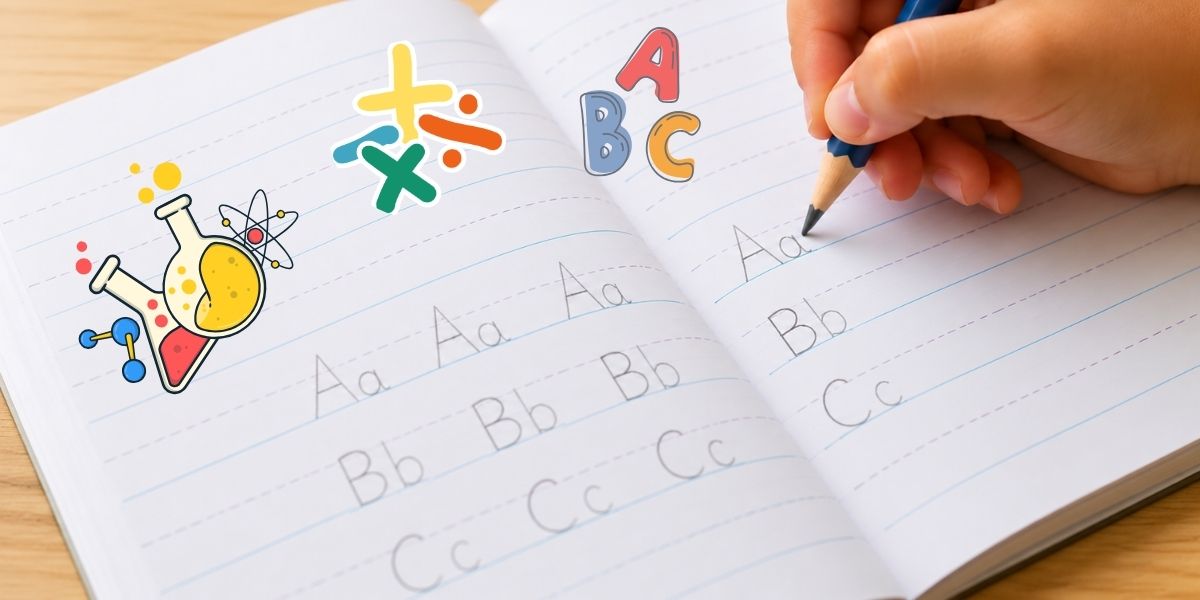
Handwriting exercise books are often seen as something that belongs only in handwriting lessons. In practice, they can be useful far beyond that.
Many pupils can write neatly during a short handwriting session, but struggle to keep the same standard in English, science, history, or RE. Handwriting exercise books can help bridge that gap by giving children a more consistent page layout and clearer writing guidance while they build stronger habits.
Key points
- Handwriting exercise books can support writing habits beyond dedicated handwriting lessons.
- They are useful when neat handwriting does not transfer into normal classroom work.
- Schools can use them in English, guided writing, interventions, and home practice.
- They help reinforce letter size, spacing, and line placement across different subjects.
- They work best as part of a wider handwriting approach, not as a stand-alone fix.
Why handwriting does not always transfer

A common challenge in schools is that pupils can produce neat handwriting in focused practice, but lose that consistency in everyday classwork.
This usually happens because classroom writing asks children to do several things at once. They are thinking about ideas, spelling, punctuation, and task instructions, all while trying to control handwriting on the page. If handwriting habits are not yet secure, presentation often slips as soon as the wider task becomes more demanding.
That is where handwriting exercise books can help. They keep more of the handwriting support in place while pupils practise using those skills in a more natural writing context.
What handwriting exercise books help with
Handwriting exercise books can support pupils with:
- keeping letters a more even size
- placing letters correctly on the line
- improving spacing between words
- building more consistent presentation
- developing confidence through repetition
Books with shaded lines can be especially useful because they make the writing space easier to read. Morrells says its handwriting exercise books are designed to help children transfer neat handwriting into other subjects, with shaded lines guiding letter height and the placement of ascenders and descenders.
Where schools can use them

Handwriting exercise books do not need to replace every ordinary classroom book. They are usually most effective when used in specific parts of the school day where extra writing structure is most helpful.
1. Handwriting lessons
This is the most obvious place to use them. A dedicated handwriting book keeps practice in one place and makes it easier to track progress over time.
2. Guided writing
These books can work well in guided writing sessions where the teacher wants to focus on presentation as well as sentence content. Pupils get more support from the page while still using handwriting in a meaningful writing task.
3. English work
Some schools may choose to use handwriting exercise books for selected English activities, especially when pupils are still developing consistency and are not yet ready to maintain neat writing in a standard ruled book.
4. Intervention groups
Handwriting exercise books are especially useful for short-term intervention work. They can give pupils more repetition and structure without needing a completely separate handwriting scheme for every child.
5. Home practice
They can also be useful for home support. A familiar page layout makes it easier for parents and carers to reinforce the same handwriting expectations children see in school.
Why consistency across subjects matters
When pupils are expected to write neatly only in handwriting lessons, they can start to treat handwriting as a separate activity rather than part of all written work.
Using handwriting exercise books more deliberately across different contexts helps reinforce the message that presentation matters everywhere, not just in one lesson a week.
This can help teachers strengthen:
- letter size
- word spacing
- line placement
- pride in presentation
- general writing fluency
It also makes progress easier to spot because pupils are practising handwriting in more than one context.
When they are most useful
Handwriting exercise books are usually most useful when:
- pupils can form letters correctly but struggle to keep writing neat in classwork
- presentation is inconsistent across subjects
- a school is focusing on improving handwriting standards
- intervention pupils need more support before moving into ordinary exercise books
- staff want a clearer bridge between handwriting practice and everyday writing
They are less about replacing general exercise books and more about giving the right pupils the right level of support at the right time.
A practical way for schools to use them
A simple approach is to use handwriting exercise books where they will make the biggest difference rather than everywhere at once.
For example, a school might:
- use them in handwriting lessons across KS1
- keep them for targeted English tasks in KS2
- use them for intervention pupils who need extra structure
- send them home as part of a short handwriting support plan
That kind of focused use is often more effective than a blanket rollout.
Final thought
Handwriting exercise books work best when they are used as a bridge between handwriting practice and everyday classroom writing. They give pupils more support while they build habits that can later transfer into normal exercise books.
For schools trying to improve handwriting consistency across the curriculum, they can be a practical and flexible tool, especially when used alongside clear teaching, modelling, and regular practice.
Sources
- Forward Education Reading & Handwriting Books collection: https://forwardeducation.co.uk/collections/reading-handwriting-books
- Morrells Exercise Books: https://morrellshandwriting.co.uk/category/exercise-books/
- Morrells blog, Morrells Launch New Range of Handwriting Exercise Books: https://morrellshandwriting.co.uk/blog/morrells-launch-handwriting-exercise-books/
- Morrells blog, Why shaded lines matter in handwriting development: https://morrellshandwriting.co.uk/blog/why-shaded-lines-matter-in-handwriting-development/


