

Choosing the best handwriting books for primary school is easier when you focus on what pupils can already do, rather than selecting a book by age or year group alone.
Some children need support with letter formation, while others are ready to learn joins or improve their writing fluency. This guide explains the main options for KS1 and KS2 and what schools should consider before ordering.
Key points
- Choose handwriting books by ability and development stage, not age alone.
- KS1 pupils often need support with pencil control, letter formation, size and spacing.
- KS2 resources should increasingly support joined writing, fluency and speed.
- Wide or shaded lines provide more guidance, while narrower lines suit more confident writers.
- Schools may need several book types to support whole-class teaching and targeted interventions.
Start with the pupil’s current handwriting stage
The best handwriting book is the one that addresses the next skill a pupil needs to develop.
Before choosing, look at whether pupils can:
- form lower-case and capital letters correctly
- keep letters a reasonably consistent size
- position letters accurately on the line
- leave suitable spaces between words
- use a pencil comfortably
- join letters without reducing legibility
- maintain their handwriting during longer pieces of work
The national curriculum introduces handwriting progressively. In Year 1, pupils focus on posture, pencil grip and correct letter formation. During Year 2, they begin using some of the strokes needed to join letters once formation is secure. In KS2, the focus moves towards consistent, legible and increasingly fluent handwriting.
Choosing handwriting books for KS1

KS1 covers a wide range of development. A Year 1 pupil learning individual letter shapes may need a very different resource from a Year 2 pupil who is nearly ready to begin joining.
Letter formation workbooks
Letter formation books are the best starting point when pupils are still learning:
- where each letter begins
- the correct direction of movement
- lower-case and capital letter shapes
- consistent letter size
- handwriting families
Morrells Letter Formation workbooks group letters with similar movements together and progress from individual letters to words and sentences. This gives schools a structured route through the early stages of handwriting.
These books are particularly useful for:
- Reception and early KS1
- pupils with insecure letter formation
- handwriting intervention groups
- children who have developed incorrect formation habits
Wide lined handwriting exercise books
Wide lined books give early writers more room to control letter size and placement.
They are a sensible choice when pupils:
- produce letters of very different sizes
- struggle to keep writing on the line
- need clearer guidance for ascenders and descenders
- find ordinary ruled exercise books too cramped
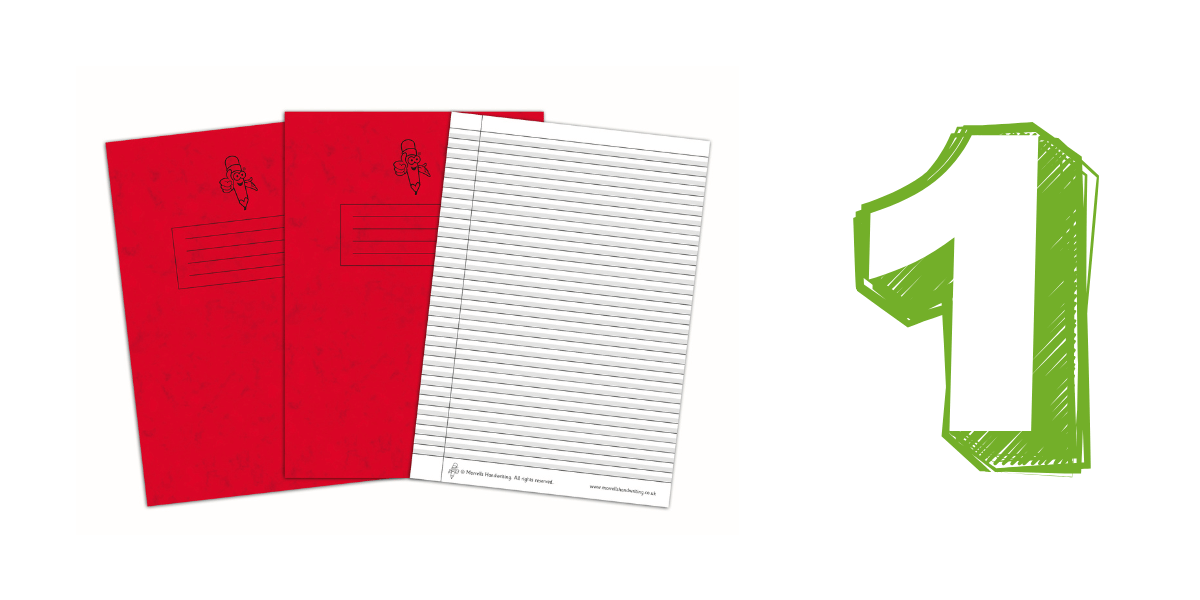
Shaded handwriting lines provide an additional visual guide by showing the main writing area more clearly. Morrells exercise books use shaded lines to support letter height, size and placement.
Split-page books
Split-page handwriting books combine a blank area for drawing with handwriting lines underneath.
They can be useful for:
- captions
- picture stories
- early sentence writing
- topic work combining illustrations and text
This format allows younger pupils to develop handwriting within a meaningful classroom activity rather than keeping it entirely separate from their other work.
Early joining workbooks
Pupils should begin joining only when individual letter formation is secure. The Year 2 programme of study says pupils should start using some joining strokes and understand that certain letters are better left unjoined.
A structured joining workbook can then introduce one type of join at a time without expecting pupils to join every word immediately.
Choosing handwriting books for KS2

In KS2, handwriting resources should help pupils move from careful practice towards legible, fluent everyday writing.
Joining Letters workbooks
Joining workbooks suit pupils who can already form letters securely but need structured support with cursive handwriting.
The Morrells Joining Letters range progresses through:
- individual joins
- joined words
- joined sentences
Similar joins are grouped together, helping pupils practise repeated movement patterns before applying them to longer writing.
These books may be useful for:
- pupils beginning joined handwriting
- children whose joins are inconsistent
- KS2 handwriting interventions
- pupils who need to rebuild poor cursive habits
Narrow lined handwriting exercise books
Narrower handwriting lines are generally more suitable once pupils can control letter size and placement confidently.
They support the move towards:
- more natural classroom writing
- smaller and more controlled letter shapes
- increased writing fluency
- longer pieces of independent work
However, not every KS2 pupil will be ready for narrow lines. Pupils who still struggle with size or positioning may make better progress using wide or shaded lines for longer.
Books for fluency and everyday writing
By Years 5 and 6, pupils should be developing legible, fluent handwriting with increasing speed. They should also learn when joined or unjoined writing is most suitable for a task.
At this stage, handwriting exercise books should provide enough guidance to maintain good habits without making pupils dependent on heavy scaffolding.
What should schools compare before buying?
Purpose
Decide what the book needs to achieve:
- teaching letter formation
- introducing joins
- improving fluency
- supporting an intervention
- transferring neat handwriting into classroom work
A workbook teaches a sequence of skills. An exercise book provides space to apply and practise them. Many pupils will benefit from using both.
Line spacing
Choose:
- wide lines for early writers or pupils needing more support
- narrow lines for pupils with better control
- shaded lines for clearer guidance on letter height and placement
- standard handwriting rulings, such as 6,4,6 mm or 7,6,7 mm, for general classroom handwriting practice
Page size and layout
A4 books provide plenty of writing space and are practical for classroom work, interventions and tracking progress. Morrells handwriting exercise books use an A4 format and include a margin on each page.
Split-page books may suit younger pupils, while full handwriting pages are better for repeated practice and longer written tasks.
Level of guidance
Some pupils need:
- directional arrows
- letters to trace
- handwriting-family exercises
- shaded writing areas
- repeated examples
More confident writers may only need appropriate line spacing and regular teacher feedback.
Teacher support
A whole-school handwriting programme works more effectively when teachers use consistent terminology, letter shapes and joining methods.
The Morrells Teacher’s Book provides teaching notes and additional letter-formation and cursive exercises that can support classroom teaching and interventions across different ability levels.
Quick handwriting book selector
| Pupil need | Suggested resource |
|---|---|
| Learning individual letter shapes | Letter Formation workbook |
| Moving from letters to words and sentences | Advanced Letter Formation workbook |
| Ready to begin joining | Introductory Joining Letters workbook |
| Practising joined words and sentences | Joining Letters progression books |
| Struggling with letter size or placement | Wide shaded-line exercise book |
| Developing more controlled everyday writing | Narrow lined exercise book |
| Combining drawing and early writing | Split-page handwriting book |
| Needing targeted extra practice | Workbook plus handwriting exercise book |
Should KS1 and KS2 use the same handwriting books?
Usually not.
A whole-school approach should be consistent, but the resources should still reflect each pupil’s stage. KS1 classrooms may use more letter-formation books and wide lines, while KS2 classes are more likely to need joining practice, narrower lines and resources that build speed and fluency.
Schools may also need different books within the same class. Providing additional structure is more helpful than moving a pupil onto a harder format simply because their classmates have progressed.
Final thought
The best handwriting books for KS1 and KS2 are not necessarily the ones labelled for a particular age. They are the ones that match the pupil’s current skills and provide a clear next step.
For most schools, a balanced handwriting range will include:
- letter formation workbooks
- structured joining books
- wide and narrow lined exercise books
- shaded-line options
- teacher resources for consistent modelling
This gives pupils enough support to build secure handwriting foundations, while creating a clear route towards fluent and confident independent writing.


