

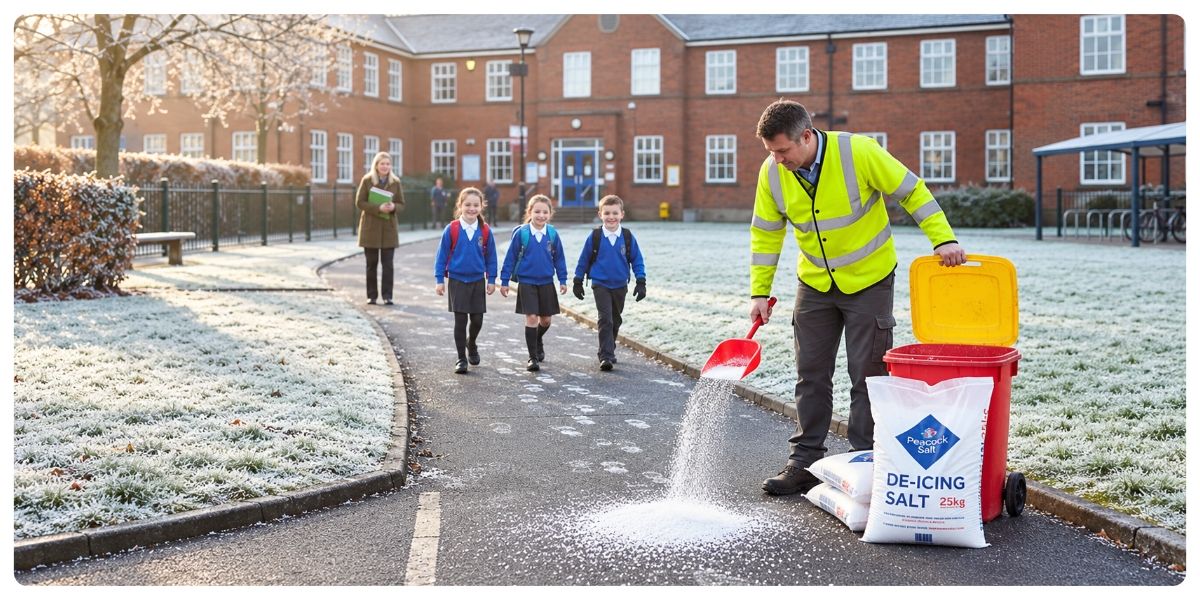
When freezing temperatures arrive, keeping school paths, entrances, playgrounds and car parks safe quickly becomes a priority for site managers and head teachers.
Both white de-icing rock salt and traditional brown rock salt can help prevent ice forming and break down existing ice. The main differences are not simply about which one "works better", but about cleanliness, cost, traction and where the salt is being used.
This guide compares brown and white rock salt to help schools choose the most suitable option for their school.
Key points
- Both white and brown de-icing salt can be effective for treating ice and snow.
- Brown rock salt is generally cheaper and can provide additional grit or traction.
- White de-icing salt contains fewer insoluble impurities and leaves significantly less visible residue.
- White salt can be particularly useful around school entrances, pathways, playgrounds and other high-footfall areas.
- Schools do not necessarily need to use the same type of salt everywhere.
- Gritting before frost develops is generally more effective than waiting until surfaces are already heavily iced.
What is brown rock salt?

Brown rock salt is the traditional de-icing salt commonly seen on UK roads, car parks and industrial sites.
It is usually mined underground and contains sodium chloride alongside naturally occurring insoluble minerals. These impurities give the salt its familiar reddish-brown appearance.
Brown rock salt has several advantages:
- generally lower purchase cost
- suitable for covering large outdoor areas
- coarse material can provide additional traction
- its colour makes it easy to see where grit has already been applied
For a school with a particularly large car park or service area, brown salt can therefore be a practical and economical option.
The compromise is cleanliness. Some of the insoluble material does not disappear when the salt dissolves, meaning brown residue can remain on paths or be carried into buildings on footwear.
What is white de-icing rock salt?

White de-icing salt performs the same basic job. Sodium chloride lowers the freezing point of water, helping prevent ice from forming and helping existing ice or snow melt.
The major difference is purity.
The White Peacock De-Icing Rock Salt supplied by Forward Education is almost 100% pure sodium chloride, sourced from the Mediterranean Sea and manufactured to meet BS 3247:2011 de-icing salt standards.
Because there is considerably less insoluble material, white salt leaves little to no visible residue after melting.
For schools, that can make it particularly attractive around areas where pupils, staff and visitors regularly move between outdoors and indoors.
White rock salt vs brown rock salt
| Feature | White de-icing salt | Brown rock salt |
|---|---|---|
| Main ingredient | Sodium chloride | Sodium chloride |
| Appearance | White/translucent | Brown/reddish |
| Typical source | Evaporated marine salt | Underground mining |
| De-icing ability | Effective | Effective |
| Visible residue | Very little | More noticeable |
| Additional grit | Lower | Generally higher |
| Typical cost | Usually higher | Usually lower |
| Particularly suited to | Entrances, paths, playgrounds and high-footfall areas | Large car parks, service areas and general gritting |
Neither is automatically the "better" de-icing salt. The right option depends on the area being treated and the priorities of the school.
Why might schools choose white de-icing rock salt?
1. Less residue around school entrances
One of the biggest benefits of white rock salt for schools is cleanliness.
Brown grit can leave visible deposits behind once the ice has melted. On a busy school site, those particles can then be carried into reception areas, corridors and entrance mats by hundreds of pairs of shoes.
White salt contains far less insoluble material, helping reduce the amount of visible residue left behind. This makes it particularly useful around main entrances and high-footfall pedestrian routes.
2. Cleaner playgrounds and pathways
Appearance is not always the biggest priority during icy weather, but school sites still need to be maintained.
White de-icing salt is a useful option for:
- school pathways
- playgrounds
- main entrances
- staff entrances
- pedestrian routes
- steps and ramps
- routes between school buildings
These are exactly the types of frequently used outdoor areas that HSE guidance recommends identifying and managing when ice, frost or snow is forecast.
3. Suitable for hand spreading or salt spreaders
School sites can vary enormously in size. A small entrance might be treated manually, while larger playgrounds or pathways may be easier to cover with a spreader.
Forward Education's White Peacock De-Icing Rock Salt is suitable for both hand application and mechanical spreaders.
4. High-purity de-icing salt
The White Peacock salt supplied by Forward Education is described as almost 100% pure sodium chloride and conforms to BS 3247:2011.
For comparison, BS 3247 specifications permit de-icing salts containing at least 90% soluble chloride compounds expressed as sodium chloride, alongside limited amounts of insoluble material.
Its high purity is therefore an important distinction from traditional brown grit.
Where does brown rock salt make sense for schools?
Brown salt still has some genuine advantages.
For example, a secondary school with a large staff car park may prioritise cost-effective coverage and traction rather than appearance. In that situation, brown rock salt can make perfect sense.
It can be particularly suitable for:
- large car parks
- delivery yards
- service roads
- vehicle routes
- back-of-school areas
- large areas requiring frequent treatment
Its natural grit can also contribute some additional traction on slippery surfaces.
For schools managing substantial estates, using brown salt in large vehicle areas and white salt around pedestrian areas can be a sensible compromise.
Which rock salt is best for school paths?
For busy school paths and pedestrian walkways, white de-icing salt has a particularly strong advantage because it combines effective de-icing with a cleaner finish.
This can be useful around routes where children regularly move between playgrounds and classrooms.
HSE guidance specifically identifies building entrances, pedestrian walkways, car parks, slopes and shaded or wet areas as locations where organisations should assess the risk of ice.
If avoiding muddy-looking residue and reducing the amount of grit carried indoors are priorities, white salt is likely to be the more suitable choice.
Which rock salt is best for school playgrounds?
Again, both will work as de-icing salts.
However, white de-icing rock salt for school playgrounds may be more attractive where cleanliness and presentation matter.
With large numbers of pupils crossing between the playground and school building, the lower visible residue of white salt can make subsequent cleaning easier.
Schools should still check the suitability of any de-icing salt for the particular surface being treated, particularly specialist or newly installed surfaces. White salt should not be assumed to be harmless to every material simply because it produces less visible residue.
Which rock salt is best for a school car park?
This is where the choice becomes less clear-cut.
For a very large car park, brown rock salt may offer the more economical solution, particularly where appearance is relatively unimportant.
White salt can still be used perfectly effectively and may make sense where:
- the car park is relatively small
- pedestrian routes run directly through it
- vehicles park close to the main entrance
- keeping surrounding areas cleaner is a priority
Some schools may therefore decide to use different types of de-icing salt in different zones.
When should schools apply de-icing salt?
Do not wait until pupils are arriving to discover that the playground has frozen overnight.
HSE guidance recommends gritting when frost, ice or snow is forecast. It advises that the best times can be early in the evening before frost settles and/or early in the morning before people arrive. Salt needs time to dissolve into moisture and does not work instantly.
For a school site manager, this means winter maintenance should ideally include:
- monitoring weather forecasts
- identifying priority gritting areas
- keeping sufficient salt in stock
- treating high-risk routes before school opens
- checking shaded and persistently wet areas
- ensuring grit bins and spreading equipment are ready
HSE also recommends prioritising regularly used walkways and having a system in place to manage ice and snow risk.
How much de-icing rock salt should schools keep?
That depends heavily on the size of your site and how much ground needs treating.
Forward Education supplies White Peacock De-Icing Rock Salt in 25kg bags, with bulk options currently available in quantities including 14, 21 and 40 bags.
Schools with large playgrounds, pathways and car parks should think beyond the first frost. Several consecutive freezing mornings can quickly work through a seemingly generous stockpile.
Ordering ahead also helps ensure your school doesn’t run out of rock salt when it is needed most. During peak winter periods, particularly December and January, delivery lead times can increase from 3–4 days to as much as 9–10 days. Running out during freezing conditions could leave paths, entrances and other high-traffic areas unsafe, creating an avoidable health and safety risk and potentially forcing areas of the site, or in severe cases the school itself, to close. Maintaining a suitable reserve before cold weather arrives is far safer than waiting until stocks are running low.
White or brown rock salt: which should your school choose?
A simple way to decide is to look at the area you are treating.
Consider white de-icing salt when:
- treating school entrances
- gritting pedestrian paths
- treating playgrounds
- minimising visible residue is important
- reducing grit carried into school buildings is desirable
- you want a high-purity de-icing salt
Consider brown rock salt when:
- treating very large areas
- covering large car parks or service roads
- keeping material cost as low as possible is the priority
- additional coarse grit is useful
- visible residue is less important
Neither option is wrong.
For many schools, however, the cleaner finish offered by white salt makes it particularly well suited to the areas used most heavily by pupils and staff.
White Peacock De-Icing Rock Salt for Schools

Forward Education supplies White Peacock De-Icing Rock Salt in 25kg bags, specifically suited to school winter maintenance.
It offers:
- almost 100% pure sodium chloride
- little to no visible residue after melting
- BS 3247:2011 conformity
- suitability for hand spreading or spreaders
- bulk quantities for larger school sites
- effective coverage for paths, playgrounds and other high-traffic areas
For site managers preparing for winter, keeping a suitable stock of de-icing salt before temperatures drop can make those icy 7am mornings considerably easier to manage.
View White Peacock De-Icing Rock Salt 25kg
Sources
- Health and Safety Executive: Slips and Trips FAQs, including winter gritting guidance
- Health and Safety Executive: Ice, frost, snow and gritting guidance
- Forward Education: White Peacock De-Icing Rock Salt 25kg
- Stone & Surfaces Direct: White Salt vs Brown Rock Salt
- IceThaw: How Salt Melts Ice and White vs Brown Rock Salt


