

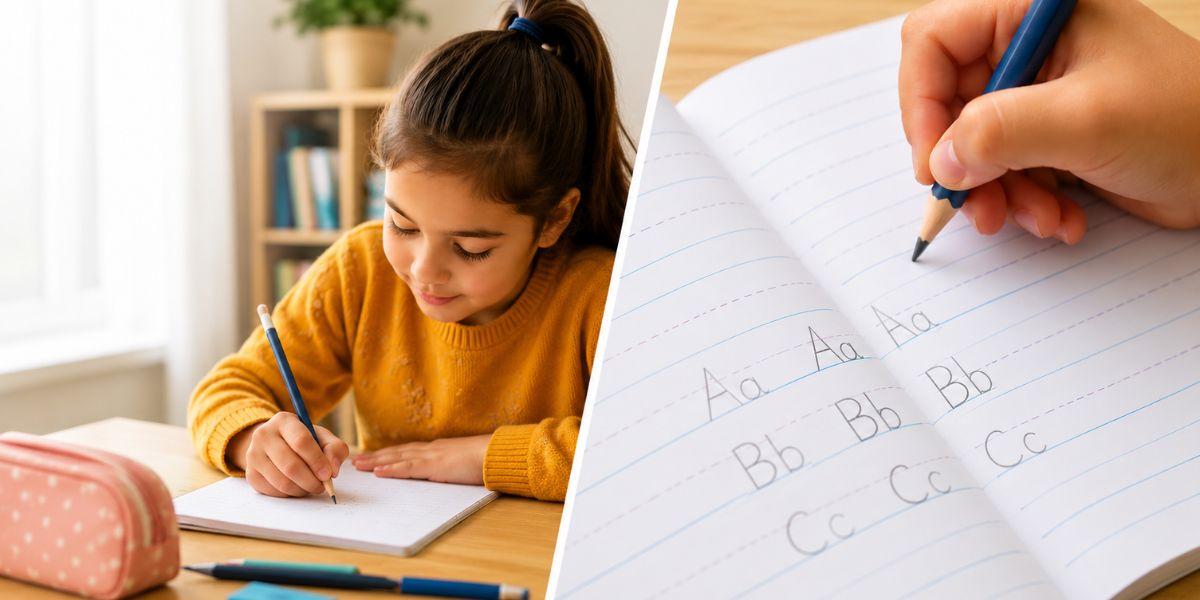
Choosing between wide lined and narrow lined handwriting exercise books can feel like a small detail, but it can make a big difference to how comfortable and confident pupils feel when they write. The right choice depends on how much support a child still needs with letter size, spacing, and line placement.
Key Points
- Wide lined books usually suit earlier writers and pupils who need more support with size and positioning.
- Narrow lined books are better for pupils who are ready for more controlled, fluent writing.
- Shaded lines can make the page easier to read and help children judge letter height more accurately.
- The best choice depends on handwriting stage, not just year group.
- Schools may need both wide and narrow lined options across different classes or support groups.
Why Line Spacing Matters
Handwriting is not only about forming the right letters. Pupils also need to control size, spacing, height, and rhythm on the page.
If the writing space is too tight too early, writing can become cramped and inconsistent. If the space stays too wide for too long, pupils may find it harder to move towards more fluent everyday writing. That is why line spacing should be chosen to match the writer, not just the stock cupboard.
When Wide Lined Books Are the Better Choice

Wide lined handwriting books are usually the better fit when pupils still need stronger visual support.
They are especially useful for:
- younger pupils
- early handwriting development
- pupils who are still inconsistent with letter size
- children who need help placing ascenders and descenders correctly
- intervention groups needing extra structure
Morrells says its wide lined books use shaded lines to help children judge the correct size and height of each letter. Morrells also offers free practice paper guidance saying wide lined paper is ideal for Key Stage 1 and matches the line style used in its earlier Letter Formation and Joining Letters workbooks.
In simple terms, wide lines give children more room to think, place, and control their writing.
When Narrow Lined Books Are the Better Choice
Narrow lined books are usually more useful once pupils have stronger control and are ready to write more fluently in a tighter space.
They are often a better fit when pupils:
- already form letters correctly
- can keep writing fairly even on the line
- are moving towards neater everyday classroom writing
- no longer need as much visual space for each letter
Morrells says its narrow lined practice paper is ideal for Key Stage 2 and above. That does not mean every KS2 pupil should automatically move to narrow lines, but it does show the general progression: wider lines first, narrower lines later.
Why Shaded Lines Help

Line width is only part of the decision. The page design matters too.
Morrells’ recent writing on shaded lines explains that these visual cues help children understand where letters should sit and how tall they should be. This can reduce confusion and make it easier for pupils to keep their writing more consistent.
That means a well-designed wide lined or narrow lined book may be more useful than a plain ruled book, because the layout itself supports the handwriting habit you are trying to build.
Should Schools Choose by Year Group?
Year group can be a starting point, but it should not be the only factor.
A better question is: what does this pupil’s handwriting look like right now?
Wide lined books are often the stronger choice if a pupil is still struggling with:
- uneven letter size
- poor line placement
- inconsistent spacing
- slow and effortful formation
Narrow lined books are more suitable when those basics are more secure and the next goal is fluency and presentation.
In practice, many schools may need both formats across different classes, interventions, or pupil groups.
A Simple Way to Choose
If you are unsure, use this quick guide:
Choose wide lined if:
- pupils still need more space and structure
- handwriting size and placement are inconsistent
- you are buying for earlier-stage writers
Choose narrow lined if:
- pupils already have better control
- the goal is neater, more fluent classroom writing
- they are ready for less support from the page
Choose shaded line books if:
- pupils benefit from clearer visual guidance
- letter height and positioning are still a challenge
- you want stronger support than standard handwriting rulings alone
Final Thoughts
The best handwriting book is not simply the one with wider or narrower lines. It is the one that gives the pupil the right amount of support for their current stage.
For most schools, the most practical approach is to use wide lined books earlier, move to narrow lined books as control improves, and use shaded line formats where pupils need clearer guidance on the page.
Sources
- Morrells exercise books category: https://morrellshandwriting.co.uk/category/exercise-books/
- Morrells Handwriting Exercise Book Bundle: https://morrellshandwriting.co.uk/product/handwriting-exercise-book/
- Morrells blog, Why shaded lines matter in handwriting development: https://morrellshandwriting.co.uk/blog/why-shaded-lines-matter-in-handwriting-development/
- Morrells free handwriting resources: https://morrellshandwriting.co.uk/free-handwriting-resources/
- Morrells blog, Morrells Launch New Range of Handwriting Exercise Books: https://morrellshandwriting.co.uk/blog/morrells-launch-handwriting-exercise-books/
- Morrells blog, Teaching Strategies for Handwriting linked to Writing Framework: https://morrellshandwriting.co.uk/blog/key-teaching-strategies-for-handwriting-in-the-new-writing-framework/


